From Puzzle Piece to Warehouse Heartbeat
2026-08-05 Automation 4 minAs KION marks its 20th anniversary, we are looking at how automation has evolved since 2006: from individual applications to the center of modern warehouse operations. What was once one piece of the puzzle has become the heartbeat of increasingly connected, intelligent and autonomous material flows.
Warehouse throughput has multiplied, and technology has advanced in major leaps. By any measure, warehouse automation has come a long way since KION was founded 20 years ago . Yet from inside the industry, that progress often felt more gradual than it may look in retrospect. That is how Pas Tomasiello sees it, reflecting on the evolution of warehouse automation since 2006.
Pas has seen that evolution up close. An Australian engineer by training, he joined Dematic in 2001 as an Integrated Systems Consultant. Today, he serves as Dematic’s Vice President Sales & Solutions Development for the EMEA region.
Looking back, Pas describes the early days of warehouse automation as “rudimentary.” At the time, the industry was still largely focused on mid-level automation – essentially the automation of movements within the warehouse. „Today, automation is increasingly about the more complete automation of the entire warehouse, with improvements across all areas making solutions much more complex and much more sophisticated,“ he says.
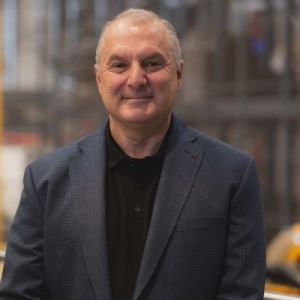
Today, automation is increasingly about the more complete automation of the entire warehouse, with improvements across all areas making solutions much more complex and much more sophisticated.
Pas Tomasiello, Vice President Sales & Solutions Development at Dematic EMEAAhead of Demand
Pas points to a recurring pattern: new technology was often ahead of the market. “The opportunity was there,” he says. “The appetite to adopt was not.” For a long time, many customers looked at automation through a narrow lens, focusing primarily on individual process steps and financial considerations.
That perspective began to shift as global crises and market disruptions exposed the limits of conventional warehouse operations. Companies started to see automation less as a cost factor and more as a competitive advantage. The questions changed accordingly. “People started to ask: What will automation do to my business?” Pas explains. “If I use automation, can I make fewer errors? Can I deliver faster?”
A New Logic
The Dematic Multishuttle is one example of how this new way of thinking translated into technology: an automated storage and retrieval system that actively manages inventory and streamlines warehouse operations. By changing the logic of the warehouse from people-to-goods to goods-to-people, the Multishuttle illustrates how automation moved beyond individual process steps and began to reshape the warehouse as a whole.
So for Pas, the real game changer was not a single technology, but the way customers began to think about automation. In another major part of KION – the Industrial Trucks & Services segment – Frank Wiezorek saw that shift play out in a very concrete way: through one customer in particular.

A Customer Moment
At the time, Frank was a Key Account Manager for a global customer, working with conventional forklift trucks and warehouse equipment. Then came an unexpected request: his customer wanted to automate its entire operation. Frank took on the challenge – and it has shaped his work ever since. Today, he serves as Senior Director Steering and Sales Development, Automation Business Unit for KION’s Industrial Trucks & Services segment in the EMEA region.
According to Frank, how far automation has moved into what was once a traditional forklift truck business can be seen clearly in the individual brand presentations of Linde Material Handling or STILL at LogiMAT , the industry’s annual trade fair. “A few years ago, automation still happened in one corner of the booth,” he says. “At the last show, automation was the core visual center piece of the entire stand.”
Beyond the Truck
The shift is also reflected in KION’s portfolio. Since 2006, the company has moved far beyond its roots as a forklift truck manufacturer: first toward integrated intralogistics solutions, and, especially since Dematic joined KION in 2016, toward end-to-end supply chain solutions.
For the ITS brands, automation is no longer simply an add-on to the traditional forklift truck business. Today, every new project begins with a broader understanding of the customer’s processes. As Frank Wiezorek puts it, the message to the customer is: “We can help you translate the entire process into an automated solution.”
Shared Strengths
Within KION, the brands bring different strengths to that ambition. Dematic contributes deep automation expertise and extensive project experience across a broad range of warehouse and distribution environments. Linde MH brings automated industrial trucks, comprehensive process expertise and proven intralogistics solutions to the table. So does STILL.
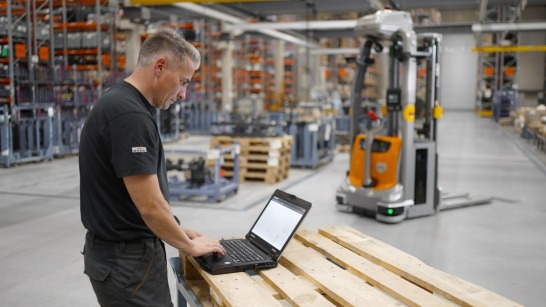
In some cases, the brands work together: Dematic may provide the core warehouse automation, such as Multishuttle systems, while an ITS brand adds automated industrial trucks and their own process expertise to the overall solution.
From the ITS perspective, Frank says, another major step has come this year: automated truck loading and unloading. Introduced as a world premiere at the LogiMAT fair in spring, the solution addresses a need many customers had been pointing to for years. “We are leading the innovation in this field,” he says.

What Comes Next
From the Dematic perspective, Pas also sees the evolution as far from over. More milestones will follow, including some that are hard to anticipate today. As for the next 20 years, he is careful not to make overly specific predictions. “If I knew what the world would look like in a few years, I’d be a rich man,” he says with a laugh.
Still, he sees two developments that could shape the next phase of warehouse automation. The first is the continued rise of mobile and flexible automation. In his view, companies will increasingly complement or replace fixed systems “bolted to the ground” with more flexible forms of automation, including AMRs, AGVs and adaptable pallet storage solutions.
Future Workforce
The second is the arrival of humanoid robots in the warehouse. Pas expects them to become a “new workforce in the warehouse,” taking on tasks that are still difficult to automate today, such as picking and packaging. “Humans are very good at identifying a specific pencil in a box and taking it out,” he says. “But we will reach the point where humanoids can outperform us even there.”
Even so, Pas does not see humans disappearing from the warehouse anytime soon. For now, the focus is less on full replacement than on reducing labor pressure and supporting people in increasingly demanding operations.
Over time, he expects AI and humanoid robots to work together, opening up further potential for progress across warehouses and supply chains. How quickly that future takes shape remains uncertain. But as Pas’s view of the past suggests, the next phase of automation may again be more gradual than it looks from the outside.
FAQ
Warehouse automation has moved from individual applications to the center of modern warehouse operations. Today, automation is increasingly about connected, intelligent and autonomous material flows.
Companies have begun to see automation less as a cost factor and more as a competitive advantage. The key question has shifted from financial impact alone to business performance, speed, resilience and fewer errors.
The brands bring different strengths. Dematic contributed deep automation expertise for distribution centers of all sizes and complexities. Linde Material Handling on the one hand or STILL on the other provide automated industrial trucks, comprehensive process expertise and proven intralogistics solutions.
Related stories