Strong Partnerships, Smarter Warehouses
2026-10-21 Innovation 3 minHow does AI deliver results on the warehouse floor? At GTC Berlin, we explored the answer with NVIDIA and Accenture.
Traditional warehouse automation depends heavily on predefined processes and predictable operating conditions. Physical AI has the potential to change that by enabling machines to perceive their surroundings, interpret dynamic situations and adapt their actions accordingly.
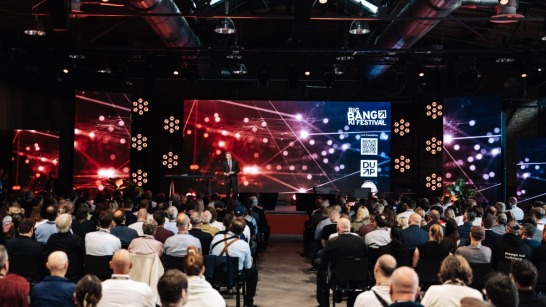
This shift was at the center of KION's presence at NVIDIA GTC Berlin 2026, where KION, NVIDIA and Accenture showcased how intelligent machines and advanced simulation technologies can transform warehouse operations. “Physical AI is a strategic enabler for orchestrating end-to-end processes across the entire supply chain – from simulation and validation to real-world operations,” said Rob Smith, CEO of KION. The partnership between NVIDIA, Accenture and KION brings this vision to life by combining our intralogistics and automation expertise with simulation technologies and integration capabilities.

Virtual to Real
Following an initial pilot in early 2026, a fleet of autonomous vehicles now operates at GXO in Épinoy alongside warehouse employees and manually operated trucks. The vehicles combine autonomous navigation with AI-supported perception to perform material-handling missions in a dynamic warehouse environment. Cameras and other onboard sensors help interpret the surroundings, while vehicle control software translates this information into physical movements. The challenge is not simply moving a truck autonomously, but achieving reliable operation amid changing traffic patterns, obstacles and human activity.

Before deployment, spatial scanners captured the warehouse environment to create a digital twin, allowing critical testing and validation to take place in simulation. Powered by NVIDIA Omniverse and simulation technologies such as NVIDIA Isaac Sim, these virtual environments go beyond visual representations of a warehouse. They allow engineers to model vehicle behavior, test navigation and operational scenarios, and identify potential conflicts before physical deployment.
A critical engineering challenge is ensuring that behaviors validated in simulation can be reliably reproduced in the real warehouse. At GXO, this simulation-supported approach helped reduce on-site implementation time by more than 60%, bringing commissioning down from weeks to just a few days.
Engineering Trust
Safety is another key focus of the collaboration. KION and NVIDIA are exploring outside-in perception and safety concepts based on the NVIDIA Halos framework. External cameras and AI agents detect and locate people, robots and other objects, extending perception beyond the vehicles’ onboard sensors. This addresses a fundamental limitation of vehicle-mounted sensors: they cannot detect objects hidden behind racks, trailers or other obstacles. Outside-in perception can provide additional information about the surrounding environment, helping autonomous systems anticipate situations that would otherwise remain outside their field of view. Translating AI-based perception into safety-relevant decisions, however, requires rigorous validation and appropriate functional safety engineering. KION adapts these capabilities with intralogistics-specific data to support safe and efficient autonomous operations.

Making these technologies work in a live warehouse also requires integrating individual capabilities into a coherent operational system. Accenture’s contribution to the GXO project centers on the systems architecture underpinning the digital twin. Its role extends to modeling how equipment, autonomous systems and people interact within warehouse processes. Combining digital technology and industry expertise with KION’s intralogistics knowledge, Accenture helps connect individual automation capabilities with the requirements of the wider operation.
KION's contribution goes well beyond providing the industrial vehicles. Integrating Physical AI into real warehouse operations requires deep expertise in vehicle control, automation software, functional safety and intralogistics processes. Combining these engineering capabilities with AI and simulation technologies is essential to translating technological potential into reliable, industrial-grade solutions.
Ready to Scale
The ambition shared by KION, NVIDIA and Accenture is to translate Physical AI into measurable business value at scale. This goes well beyond deploying individual autonomous vehicles. It requires coordinating intelligent machines, integrating them with warehouse management and execution systems, and adapting to different layouts and operating processes. The next frontier is the orchestration of entire warehouse operations, where vehicles, automation systems and software work together as part of an increasingly autonomous environment.
“The future of warehouse automation is not about programming every movement. It is about creating machines that can understand their environment, make intelligent decisions and work together as part of an autonomous system. Physical AI takes us from automating individual tasks to fundamentally rethinking how warehouses operate.”- Eike Wibrow, VP Global Technology Strategy, KION Group.


Physical AI is a strategic enabler for orchestrating end-to-end solutions across the entire supply chain – from simulation and validation to real-world operations.”
Rob Smith, CEO at KION GROUP AGFAQ
NVIDIA GTC is a global AI conference. It brings together developers, researchers and industry leaders to explore advances in AI.
They aim to create measurable business value across supply chains. Their shared ambition is to help customers plan, test and improve interconnected operations and scale successful solutions across more sites.
Simulation allows critical testing and validation before physical deployment. At GXO’s Épinoy warehouse, this approach reduced on-site implementation time by two thirds.
Related stories