The State of Physical AI – With Steve Bentley
2026-07-15 Innovation 3 minWith developments in artificial intelligence moving fast, we sat down with our SVP Software & Digital, Steve Bentley, to talk about the current state of Physical AI at KION.
Steve, let’s start with the big picture. What is Physical AI?
Steve: When we talk about Artificial Intelligence, most of us think of chatbots on their smartphones. That is the purely virtual world. In logistics, however, we operate in the physical world. Here, we cannot accept mistakes, hallucinations or ‘good enough’ results because human safety is at stake. At the same time, most of the world's economy is rooted in the physical world which is a realm that AI has not yet fully touched.
This is exactly where Physical AI comes in. Simply put, it refers to intelligent systems that can sense, understand, and act within the real world.
What role does that play for KION?
Steve: For KION, it means giving our vehicles the ability to see, think, and do. No two warehouses are the same. Every installation is unique. That is exactly the problem we are solving. How do you build intelligent systems that work reliably in environments that were never designed to be standardized?
By combining our AI with our physical products, we predict what happens in these environments before it happens, optimizing the workflow, simulating the layout, and orchestrating the whole chain. The industrial use of AI is still genuinely early. By moving fast with key lighthouse customers, we earn a structural advantage. That is why Physical AI is a core pillar of our strategy, and we are proving and validating this today.

Through strategic industry alliances, we can ‘crowdsource’ the physical world data required to continuously train and improve our models.
Steve Bentley, SVP Software & Digital KION GroupKION has entered various technology partnerships. Why not do all of that alone?
Steve: The space is developing at an incredible speed. It ultimately comes down to time-to-market and scaling efficiently. We combine what we do best with the capabilities of world-class technology partners. We have fantastic in-house machine learning, vision, and perception engineers and by combing these and complementing our skills with the likes of NVIDIA, Siemens, or Accenture, we can achieve more and move much faster.
Why is warehouse data such a critical asset in this ecosystem?
Steve: While the IT space has all the virtual data it could ever need, data in the physical world is scarcer. Through these strategic industry alliances, we can ‘crowdsource’ the physical world data required to continuously train and improve our models.
How does Physical AI change the way supply chain solutions are developed?
Steve: The big benefit is that it allows us to shift complexity into a risk-free virtual world before we build anything in the physical world. This is where Digital Twins (perfect virtual representations of a physical site) changes the game.
Key here is simulation. By training models in simulated spaces like the NVIDIA Omniverse, our trucks and bots encounter and learn from countless situations before they ever experience them in the physical environment. This simulation and training process is vital because a human driver instinctively knows how to handle countless edge cases, and our autonomous trucks need to learn to process those scenarios just as efficiently. By proving all the automation, processes, and layouts upfront in this virtual world, we can compress the development time for a whole supply chain solution from years down to just months. This is a huge benefit to our industry.
That makes sense commercially. How can physical AI then benefit humans working in the warehouses?
Steve: The two most immediate benefits are enhanced safety and workforce availability. Intralogistics can be a hazardous industry due to the uniqueness of every site, which is why health and safety are front and center for us and our customers. By introducing autonomous vehicles, we actively remove some of those hazards from the human environment.
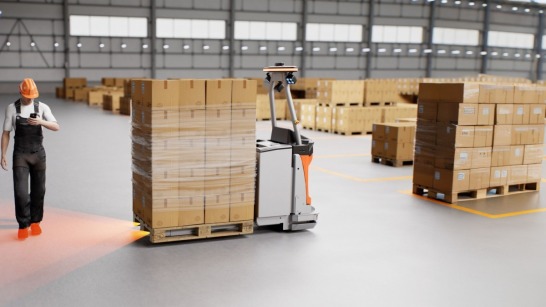
For example, our systems use real-time data to distinguish between a person and an object. If an AI-powered camera or truck identifies a person or an obstacle, it can trigger immediate action like obstacle avoidance or slowing down to protect the operator. We are even working with TÜV on a world-first safety certification for our automated trailer loading project to ensure the highest standards.
Beyond physical safety on the floor, how does this shift affect the broader labor landscape in logistics?
Steve: There is a global labor shortage in this industry. While new technology always causes a shift in the workforce, I am a technology optimist. As a society we need to shape this technology so that it is a net positive for everyone. Let the devices handle the most repetitive or dangerous tasks and allow our human operators to focus on higher-value work. We will always need the human in the loop to orchestrate, host, and maintain these intelligent fleets to keep them running efficiently.
Looking ahead, what does the future hold for Physical AI at KION?
Steve: The technology works. That is no longer the question. We have moved from theory to reality with already installed physical AI products serving our customers.
The next phase is industrialization. Confined use cases first, where we can guarantee predictability and prove the economics. As reliability compounds, autonomous devices reach a point where they are demonstrably faster and safer than manual ones. Then the cost curve drops and commercial deployment scales. This is the pattern in all new technology shifts.
What I want to solve is the chronic labor shortage every one of our customers is dealing with. And the supply chain fragility that was exposed at scale post-COVID. An always-on, self-optimizing supply chain is what the next generation of our products must deliver. That is the finish line.
FAQ
Physical AI refers to artificial intelligence that can perceive and understand its real-world environment and act autonomously. In intralogistics, it enables intelligent vehicles and systems to perform tasks safely and efficiently in the physical world.
KION combines Physical AI with autonomous vehicles and digital solutions to analyze, simulate, and optimize warehouse processes. This makes it possible to design processes more efficiently and to develop and implement supply chain solutions more quickly.
Physical AI enhances safety by enabling vehicles to detect and react to people and obstacles in real time. At the same time, it automates processes and makes warehouse operations more efficient.
Related stories