A Big Bang for AI and Intralogistics
2026-09-17 Innovation 3 minMore than 11,000 visitors, hundreds of speakers and one question at the heart of it all: what can AI deliver in the real world? At Berlin’s “Big Bang KI Festival,” KION brought the world of intralogistics to Europe’s leading AI event.
A small parcel appears on the giant screen. Plain, brown, unremarkable – the kind of box that arrives on doorsteps millions of times every day. Amid the buzz of Berlin’s Big Bang AI Festival , the neatly wrapped parcel seems almost out of place: a relic from an analogue age. But it belongs here.
The parcel is the thread running through the keynote by KION’s Senior Vice President Software & Digital, Steve Bentley. At one of Europe’s leading AI conferences, he follows the parcel on its journey through the warehouse to show how goods and supply chains move around the world – and the technological revolution already unfolding behind the scenes. Its name: Physical AI.

Behind the Click
“How many of you have ordered something online in the last seven days?” Bentley asks the audience. Hands go up across the room. Then comes his second question: Who has actually stopped to think about why that parcel arrived the next day? Almost no one. “We click ‘Buy Now’ and expect the product to show up at our doorstep shortly”, he says.
Behind that everyday convenience lie some enormous challenges for global supply chains – the invisible networks that keep not only parcels moving to our doorsteps, but factories supplied, supermarket shelves stocked and medical facilities running.
Pressure Points
These complex processes do not run themselves – and today, the industry is facing a number of major challenges. Figures from the US Bureau of Labor Statistics, the United Nations Economic Commission for Europe and PwC illustrate the scale of the pressure:
• Safety remains a major challenge: In US transport and warehousing, the rate of recordable accidents is almost twice as high as across private industry – 4.4 compared with 2.3 accidents per 100 employees.
• The workforce is aging: The number of workers aged 55 to 64 has doubled since 2000, intensifying an already chronic labor shortage.
• Logistics has a major responsibility to decarbonize: With transport and logistics accounting for 23 percent of global CO₂ emissions, reducing the industry’s environmental footprint is a pressing challenge.

Beyond Chatbots
The answer, Bentley argues, is AI. But not the kind most of us know from our smartphones and chatbots. “That is the purely virtual world,” he says. Logistics is different: it operates in the physical world, where mistakes, hallucinations or “good enough” results are not an option when human safety is at stake.
This is where Physical AI comes in: intelligent systems that can perceive their surroundings, understand what is happening and adapt their actions in real time – taking automation beyond predefined rules and into the real world.
From Steel to Software
For KION, this shift is changing the company itself. “We may have been a traditional steel and iron company in the past”, he says. Yet today, KION combines decades of industrial expertise with advanced software and Physical AI to make supply chains safer, faster and more reliable.
Bentley points to concrete examples of Physical AI already at work. One is KION’s RoCaP , a vehicle designed to robotically build mixed pallets by picking and stacking different products. Bentley calls it “a quantum leap in intralogistics” because it automates a complex task that has traditionally been done by hand.

Better Together
KION is not developing these capabilities alone. The company combines its own expertise with technology from partners such as NVIDIA and Accenture as well as high-fidelity spatial data from NavVis to create accurate digital twins of real warehouse environments. The goal is to move faster: “It’s our vision that every supply chain solution begins its life as a digital twin,” Bentley says, allowing customers to test, optimize and validate systems before they are built in the real world.
Bentley’s message is clear: KION has already moved Physical AI beyond the experimental stage. The technology is working in real-world applications; now the challenge is to connect vehicles, AI, digital twins and automation into complete systems – and scale them.
Some visitors to the AI festival may initially have wondered what an old-fashioned parcel had to do with artificial intelligence. By the end of Bentley’s keynote, the answer was clear: quite a lot.
© BIG BANG KI FESTIVAL / Fotos: Offenblende.de
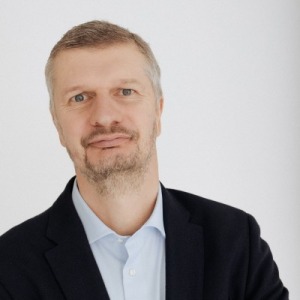
“It’s our vision that every supply chain solution begins its life as a digital twin.”
Steve Bentley, Senior Vice President Software & Digital at KIONFAQ
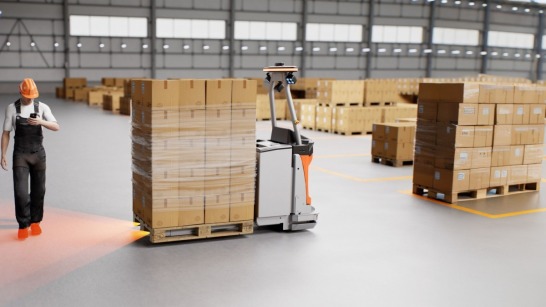
AI-powered cameras can recognize people and movement, monitor danger zones and trigger a safe stop when necessary. This makes AI part of the safety architecture rather than just an assistance system.
KION combines its own expertise with technology from partners including NVIDIA and Accenture. The partnerships are intended to accelerate the development of Physical AI and digital-twin solutions.
KION used the AI conference in Berlin to show how Physical AI is already being applied in intralogistics. Steve Bentley presented how AI can make supply chains safer, faster and more reliable.
Related stories